

Week 15: 2 May
Monday: Final class day.
We will look at radiosonde measurements and Atmospheric Wave Clouds as time permits, Assignment 9.
Radiosonde measurements video.
Radiosonde discussion for sensors in the lab.
Brief discussion of stability and potential temperature.
Radiosonde passing through a wave cloud: wet temperature sensor error, potential temperature drops with height.
Look at homework assignment slides (assignment 9).
Have students look for waveclouds using NASA Worldview for April of different years, and look at related soundings.
Week 14: 25 April
Wednesday: Presentations for Part 7 of Assignment 7. Presentations will be in rm LP 111
Monday, Wednesday and Friday: We will finish Part 7 of Assignment 7, the digital pressure sensor on Monday.
Presentations start on Wednesday for this assignment. Presentations will be in rm LP 111, next door to our classroom.
We will look at radiosonde measurements and Atmospheric Wave Clouds as time permits, Assignment 9.
Labview code for graphing and saving pressure data.
Arduino code needs minor modification to output data in a format for Labview.
Set the baud rate to 9600 baud, and have the output match the example in the 'Raw Data' box on the labview VI.
Labview code for the IR sensor can be adapted to view pressure also.
Week 13: 18 April
Monday, Wednesday and Friday: We will finish Part 6 of Assignment 7, the IR temperature sensor, and begin Part 7 of Assignment 7, the digital pressure sensor.
The Labview source code for the IR sensor was adjusted to deal with time in seconds more effectively, so you can download it again as needed to get data.
If you're finished with Part 6 of Assignment 7 you can continue with Part 7 of Assignment 7.
UNR Summer Research/Scholarship opportunity.
Snow imaging using your cell phone camera.
Week 12: 11 April
Monday: We will have presentations for the presentation part of Homework 10 at UNR, in the Physics Conference Room LP208.
Wednesday and Friday: We will finish Part 6 of Assignment 7, the IR temperature sensor, and begin Part 7 of Assignment 7, the digital pressure sensor.
Tongan explosion images, and the image showing propagation around the world. For discussion on Wednesday.
Simulation of propagation around the world (NYT).
UNR Summer Research/Scholarship opportunity.
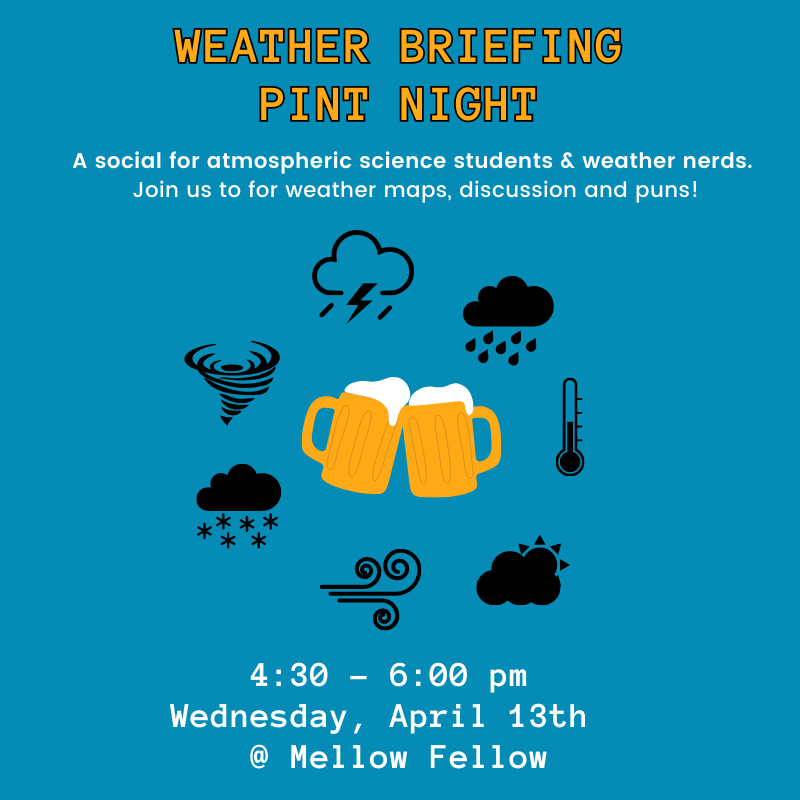
Pint Night: Informal get-together weather discussion.
California Nevada drought webinar: Update for the end of March 2022.
Instrument for snow imaging: 2D disdrometer article with data examples.
Snow imaging using your cell phone camera.
Week 11: 4 April
Zoom recording for 4/1/2022. (It isn't on WebCampus).
Monday and Wednesday: We will meet through Zoom to do the diel averages for PM2.5 and pressure.
Friday: We will have presentations for the presentation part of Homework 10 at UNR, in the Physics Conference Room LP208.
Bring questions to class about Homework 10.
Be sure you have chosen a site for the presentation part of the assignment, that looks at the PM2.5 and pressure at an interesting place in the world.
UNR Summer Research/Scholarship opportunity.
Pint Night: Informal get-together weather discussion.
We will finish Part 6 of Assignment 7, the IR temperature sensor, once we return to class and finish with Assignment 10.
California Nevada drought webinar: Update for the end of March 2022.
Primary and secondary contributions to air pollution in Mexico City.
Per capita air pollution in the world's cities.
Week 10: 28 March
NOTE: We will meet through Zoom this week.
Bring questions to class about Homework 10.
Be sure you have chosen a site for the presentation part of the assignment, that looks at the PM2.5 and pressure at an interesting place in the world.
UNR Summer Research/Scholarship opportunity.
We will finish Part 6 of Assignment 7, the IR temperature sensor, once we return to class and finish with Assignment 10.
California Nevada drought webinar: Update for the end of March 2022.
Week 9: 21 March
We will not meet in person in the classroom this week.
Instead, prerecorded lectures for Assignment 10 are to be viewed.
Be sure to follow along and do the analysis discussed in these lectures for the UNR portion of the assignment (for your report).
We will finish Part 6 of Assignment 7, the IR temperature sensor, once we return to class and finish with Assignment 10.
Monday: Introduction to this assignment, 21 March 2022 class lecture.
Wednesday: Acquiring PurpleAir network data for January 2022 inside and outside of the Physics building, 23 March 2022 class lecture.
Friday: Working with the Purple Air data to look at indoor versus outdoor air pollution, 25 March 2022 class lecture.
Week 8: 7 March
Please arrive to class on time. If you have to miss class, please let me know.
We need to work together in unison. We are working on Assignment 7, Parts 5 and 6, pressure measurements and infrared sensor measurements.
We are demonstrating their properties and use.
Monday and Wednesday: Worked on the pressure sensor.
Friday: Will start with the IR temperature sensor. We will likely need to finish this sensor after the break.
This assignment is being broken up into a separate part 5 (pressure sensor), and part 6 (IR temperature sensor).
Week 7: 28 February
Please arrive to class on time. If you have to miss class, please let me know.
We need to work together in unison. We are working on Assignment 7, Parts 3 and 4, temperature measurements.
We are getting the response time of the TMP36 and thermistor temperature sensors.
TMP36 temperature sensor data sheet.
Discussion of the TMP36 temperature sensor.
Week 6: 21 February
Note: Class cancelled for Wednesday due to the UNR Inclement Weather Delay.
Please arrive to class on time. If you have to miss class, please let me know.
We need to work together in unison. We are working on Assignment 7, Parts 3 and 4, temperature measurements.
Monday: No class, President's Day.
Wednesday and Friday: Parts 3 and 4 of Assignment 7.
We will use the same curve fitting model for the temperature sensors.
TMP36 temperature sensor data sheet.
Discussion of the TMP36 temperature sensor.
Week 5: 14 February
Please arrive to class on time. If you have to miss class, please let me know.
We need to work together in unison. We are working on Assignment 7, Part 2, and have a report due on the 18th of February.
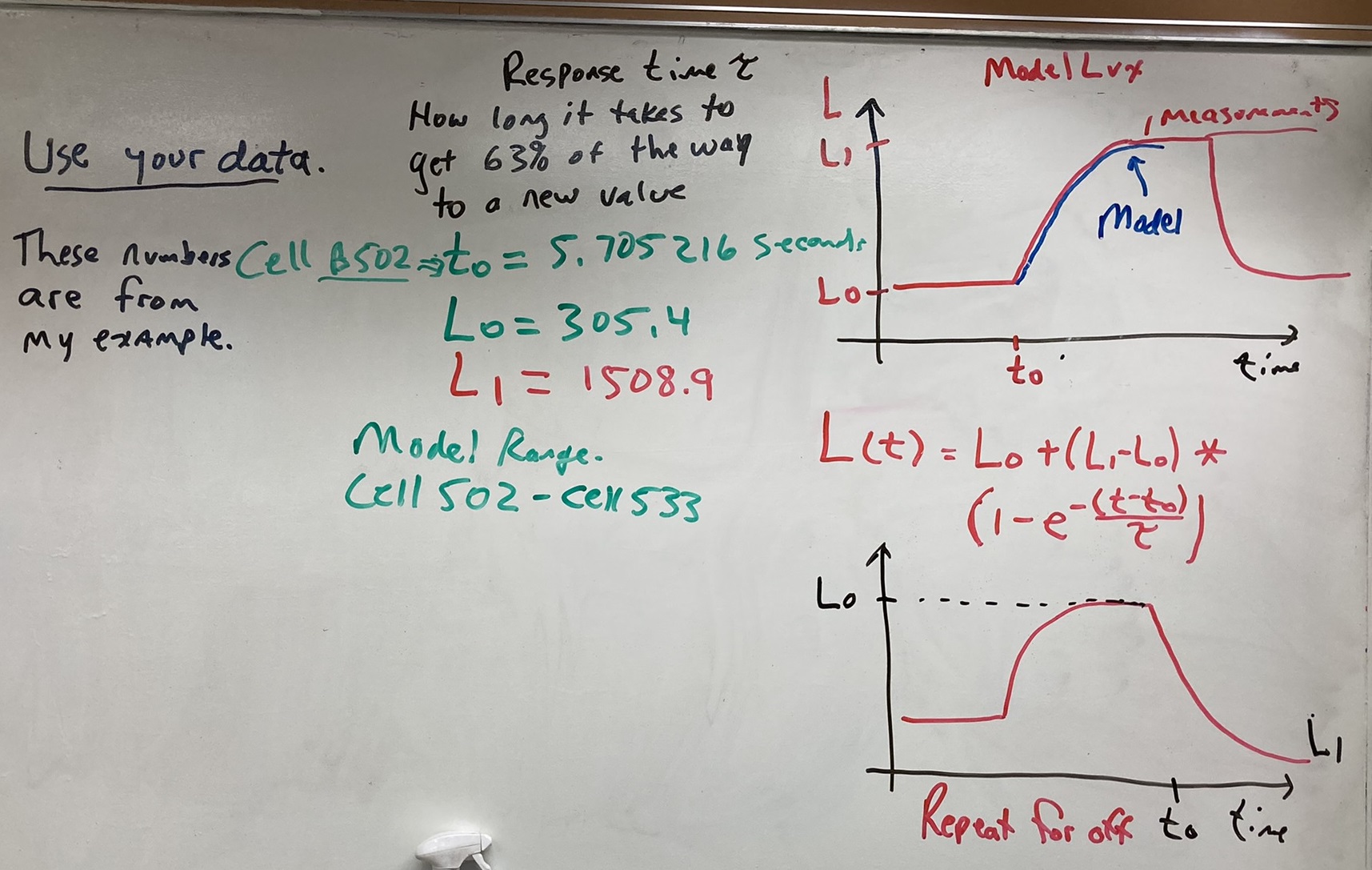
Monday: We will continue to obtain the response time of the photoresistor by fitting our data to a theoretical model.
Be ready with your data to continue working on this calculation. We will also discuss publication quality graphics.
Here's is an example from the measurements I took for reference, though you must use your own data for the report.
Here are the whiteboard notes for the curve fitting model.
We will also talk about report writing as well.
Week 4: 7 February
NOTE: When working with Arduinos, connect to USB only after you have wired up your circuit and checked it.
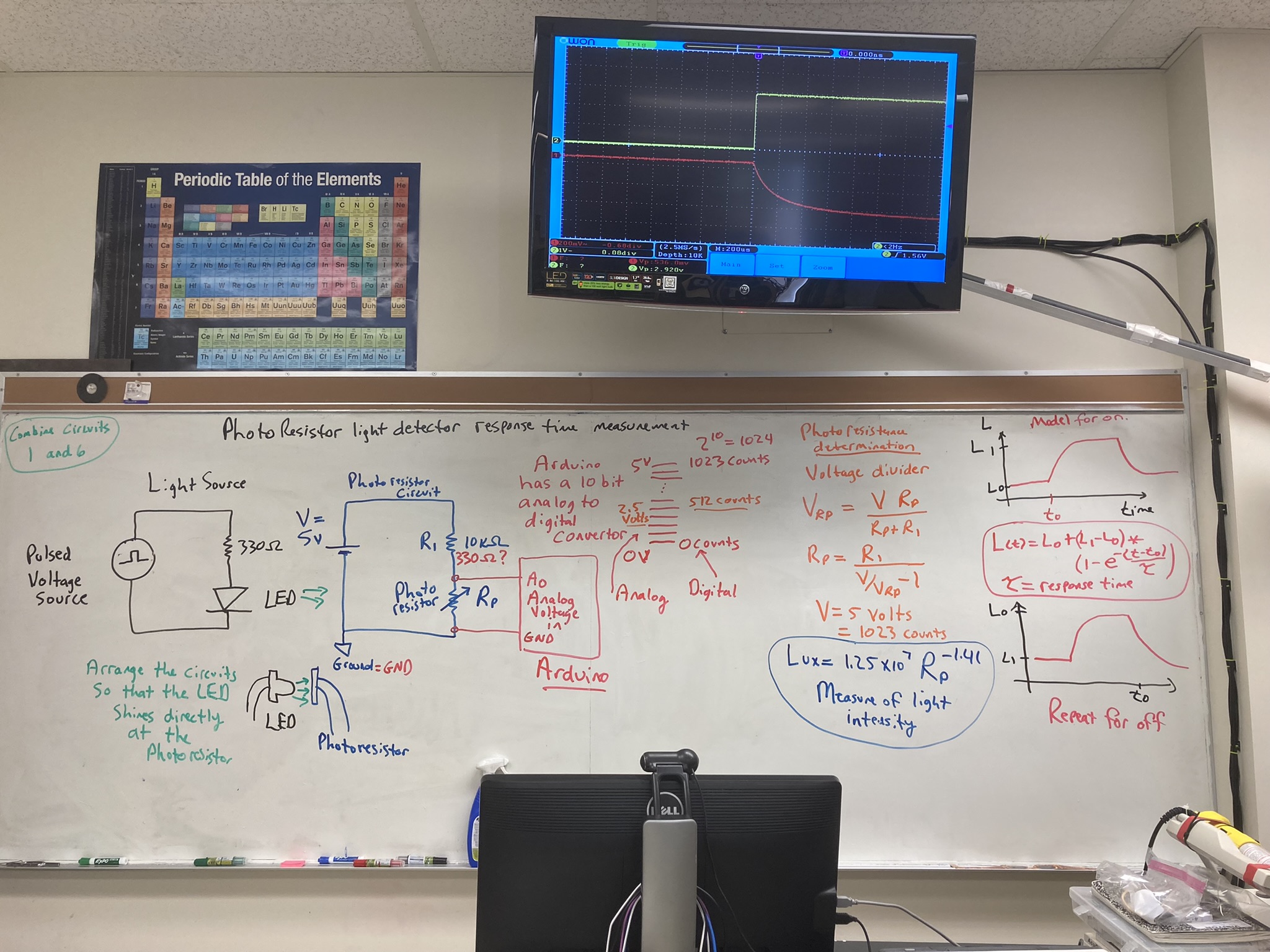
Monday: White board notes for the photoresistor response time measurement.
Friday: We will obtain the response time of the photoresistor by fitting our data to a theoretical model.
Be ready with your data to work on this calculation. We will also discuss publication quality graphics.
Continue homework 7 parts 1 and 2, working with Arduinos.
Measuring the response time of photoresistors used to detect light from an LED.
Introduce photoresistors by measuring their resistance for varying amounts of light.
Discussion of the Tongan Volcano Eruption by Dr. Neil Lareau.
Week 3: 31 January
Monday, Wednesday, and Friday Classes:
NOTE: When working with Arduinos, connect to USB only after you have wired up your circuit and checked it.
Finish homework 6 presentations.
Begin homework 7 parts 1 and 2, working with Arduinos.
Get Acquainted:
Introduce breadboarding and digital voltmeters.
Introduce resistors and color code for resistance values.
Introduce the Arduino IDE and used it to blink the LED, the first experiment in the Vilros book.
Change the blink frequency until the light looked continuous.
Look at the signal used to drive the LED with the oscilloscope.
View and discuss modified Arduino code for simplifying the observation.
|
|
 |
Manual that works with the parts kit we use in class:
Direct link
Local backup.
Software for the manual and parts kit we use in class:
Direct link
Local backup
Discussion of the Tongan Volcano Eruption by Dr. Neil Lareau.
Week 2: 24 January
Friday Class:
Homework 6 presentations start on Friday.
Wednesday Class:
Continue with the radar study, Assignment 6, discuss base velocity, the Doppler velocity data from the radar.
Weather radar presentation as powerpoint for discussing base velocity data.
Have time in class for discussions and for preparing for Homework 6 presentations that start on Friday.
Monday Class:
Continue with the radar study, Assignment 6, working with radar data.
Weather radar presentation as powerpoint and as a pdf document for understanding radar and dbZ.
Needed for homework 5 and 6.
 |
Example of current radar data.
Week 1: 17 January
Friday Class:
Continue with the radar study, Assignment 5.
A free, online Atmospheric Science textbook is available for students new to the field.
Free online Introductory Textbook for Atmospheric Science and local backup.
 |
Wednesday Class:
Introductions and orientation.
Places to learn about what is going on in this class:
Daily Notes (here).
Assignments.
Assignments 1-6 have been posted. Review all assignments.
Syllabus.
Webcampus.
How to write a lab report.
How to keep a lab notebook to record what you do and help in lab report writing.
a. Make a table of contents at the back.
b. Number the pages so you can add entries to the table of content.
Discussion of lab notebooking from CU.
Radar measurements of precipitation and air motion are very important and central to atmospheric science.
Example current data.
Weather radar presentation as powerpoint and as a pdf document for understanding radar and dbZ.
Needed for homework 5 and 6.
Atmospheric Instruments used at the DOE ARM meteorological/climate studies sites.
Meaurement uncertainty and local backup.